The Lycian Way takes you somewhere else entirely — into the heart of the landscape, and sometimes into yourself.
Stretching through the mountains and coastline of southwestern Türkiye, the Lycian Way follows ancient paths that once connected villages, valleys and cities of the Lycian civilization.
Because on the Lycian Way, the destination is only part of the experience.
The real journey happens between the places you came to see.
When the Morning Begins on the Trail
A morning on the Lycian Way feels different from an ordinary holiday morning.
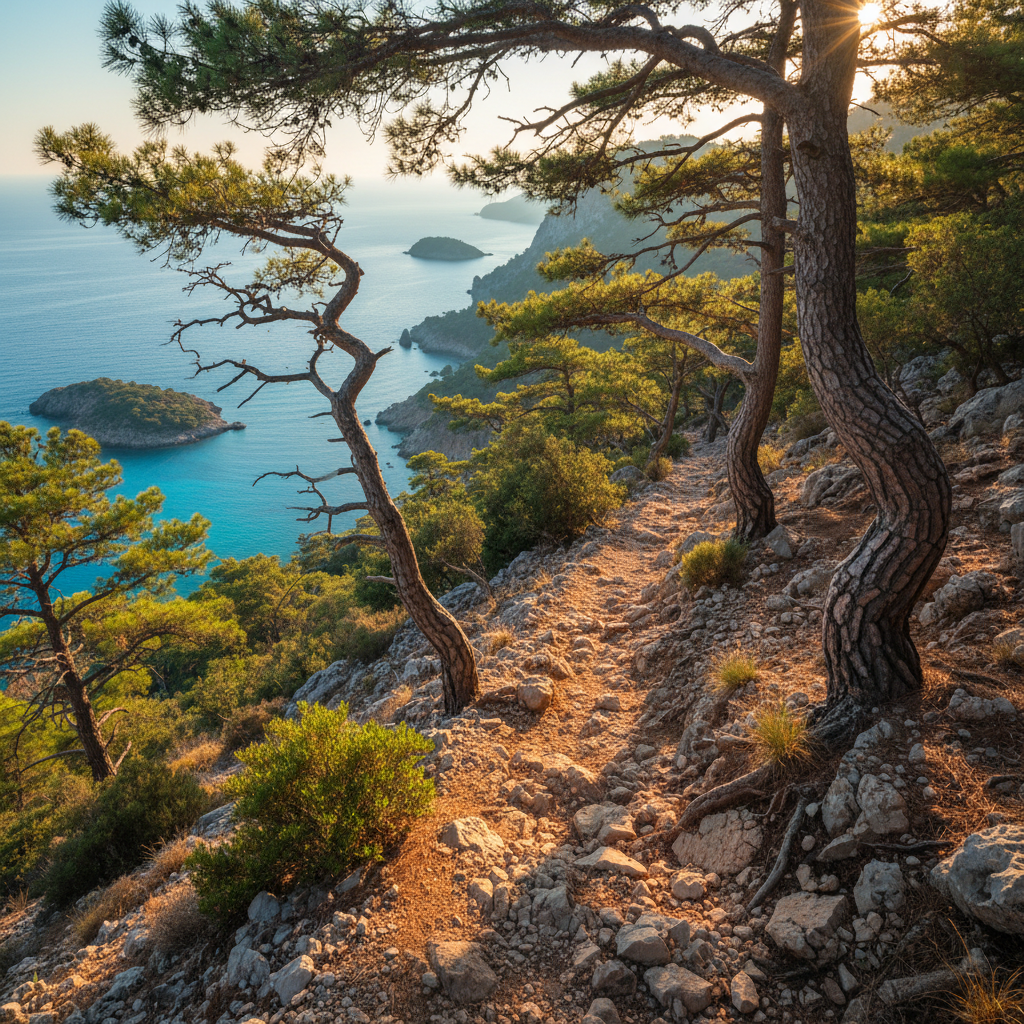
The sun begins to rise behind the mountains. The air is still cool, the forests are quiet, and somewhere below, the Mediterranean slowly begins to catch the light.
Then the path begins to climb.
Under your feet are stones that have been here for generations. Around you are pine forests, rocky slopes and views that seem almost too large for a single photograph.
For a moment, it becomes easy to forget the modern world.
There is no traffic.
No crowded streets.
Just a narrow trail disappearing into the landscape.
The Most Beautiful Part May Be the Path Itself
Many travelers come to the Lycian Way expecting ancient ruins.
And there are plenty of them.
But the most memorable moments are often completely unexpected.
A turn in the trail suddenly reveals the Mediterranean far below.
An old olive tree stands alone beside the path.
A small village appears between the mountains.
Or you walk for hours without seeing another person.
These moments are difficult to plan.
And perhaps that is exactly why they become unforgettable.
The Lycian Way doesn’t constantly try to impress you.
It simply gives you the opportunity to discover something for yourself.
Walking Through the Remains of Another World
The Lycians built their civilization in this extraordinary corner of Anatolia thousands of years ago.
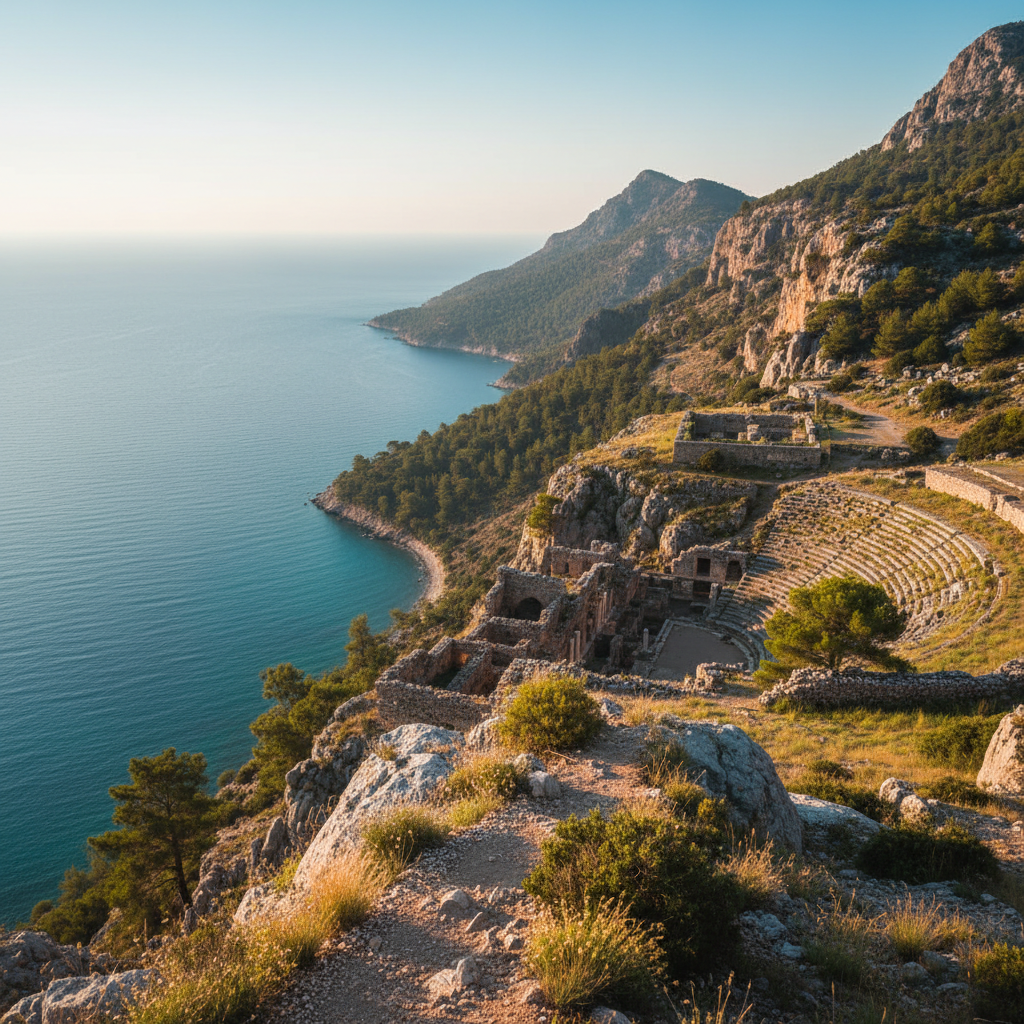
Today, traces of their world can still be found along the trail: rock-cut tombs, ancient ruins, stone structures and forgotten paths.
But history here doesn’t feel like something locked inside a museum.
You may find it beside the trail.
In a weathered stone wall.
In an ancient tomb carved into a mountainside.
Or in a road that has survived long after the people who built it disappeared.
On the Lycian Way, history is beneath your feet.
When the Sea Is Below You
There is a particular moment that many hikers remember.
You have been climbing for a while. Your legs are tired. The trail becomes rougher.
Then you stop.
Below you is the Mediterranean.
The coastline stretches into the distance, the water changing shades of blue as the sunlight moves across it.
The mountains rise behind you.
Between them is the trail.
These are the moments that make the difficult sections worthwhile.
Because on the Lycian Way, the most beautiful views are rarely found where the journey is easiest.
A Different Side of the Mediterranean
The Mediterranean is often associated with beaches, resorts and busy summer towns.
The Lycian Way reveals another side of it.
Quiet bays.
Pine forests.
Mountain villages.
Ancient ruins.
Stone houses.
Long empty paths.
And nights when the sky seems much larger than it does in a city.
Here, you don’t simply visit the Mediterranean.
You experience it from above.
What Happens When the Day Ends?
At the end of a long day, you may take off your backpack and sit down somewhere along the route.
And that’s when you may notice something unexpected.
You have barely checked your phone.
You haven’t been watching the clock.
You haven’t been thinking about the next appointment.
You have simply been walking.
Maybe you stopped for tea in a village.
Maybe you rested beneath an olive tree.
Maybe you sat quietly and watched the sea.
In a world that constantly tells us to move faster, the Lycian Way offers a different idea:
Sometimes slowing down is part of the journey.
You Don’t Have to Walk It All
One of the great things about the Lycian Way is that you don’t have to complete the entire route to experience it.
Different sections offer different landscapes, levels of difficulty and cultural experiences.
You can choose a section that matches your time, fitness and interests and build your own journey around it.
What matters is not how many kilometers you complete.
It is what you discover along the way.
Before setting out, however, it is important to plan carefully. Weather, terrain, water availability and the difficulty of individual sections can vary. Good hiking shoes, sufficient water, sun protection and appropriate preparation are essential.
And Then You Understand
At some point on the trail, you may stop without any particular reason.
You look ahead.
The Mediterranean is below you.
The mountains surround you.
Ancient stones sit quietly beside the path.
And for a moment, the distance between the past and the present seems to disappear.
That is what makes the Lycian Way different.
It isn’t simply a hiking trail.
It is a chance to step inside a landscape shaped by thousands of years of human history.
You may not remember every kilometer.
You may not remember every ancient ruin.
But you will probably remember the moment when the sea appeared beyond the mountains, the silence of a village road, or the color of the rocks beneath the evening sun.
Because some journeys are not remembered for where they ended.
They are remembered for how they made you feel while you were still on the way.
Some roads take you from one place to another.
But describing it simply as a long-distance hiking trail doesn’t really tell the story.

 RentalFindex
Yorum bırakın